What AI Cannot Digest
A personal reflection on AI, craftsmanship, judgment, and why I still write with a pen first.

The world is soaked with AI now. The technical part, the working part, the part that used to take a career to learn, is handled by automation, and everywhere I look people feel unblocked. They start producing. They start building. And then they hit the wall I hit: the market is swamped with working products, dozens of implementations of everything, seemingly available, seemingly done. How do you differentiate? And underneath that, a colder question: when anyone can build it themselves in a weekend, why would they buy it at all?
I didn’t meet this wall in a market report. I met it three times this year, in my own hands. I spent months building a harness whose core idea was review by a different model family: one AI does the work, a rival checks it, because a model grading its own homework is no check at all. Then one afternoon I replaced the whole thing with a page of instructions in plain English, a skill that tells one vendor’s agent to call another vendor’s agent with a review flag. Not a program. A note. The capability did not move to a competitor; it moved into language.
The second wall was memory. I had built machinery to carry thought across sessions and across models, versioned, deliberate, mine. Then the sessions learned to rename and resume themselves and to keep global memories out of the box, and my machinery became a description of a feature. The value wasn’t storing memory. It was designing the machinery around memory. Then the machinery disappeared into the platform.
The third is happening as I write: the open autonomous harnesses run operations end to end, and they move faster than I can type. I have spent years learning to build the machinery under intelligent systems, and the agent harnesses are taking over exactly that, the automation part, my capabilities swallowed at the speed of invention. Not stolen. Absorbed. The wave I am riding is the wave that is dissolving the ground I stand on, and it does not slow down to let me feel one way about it.
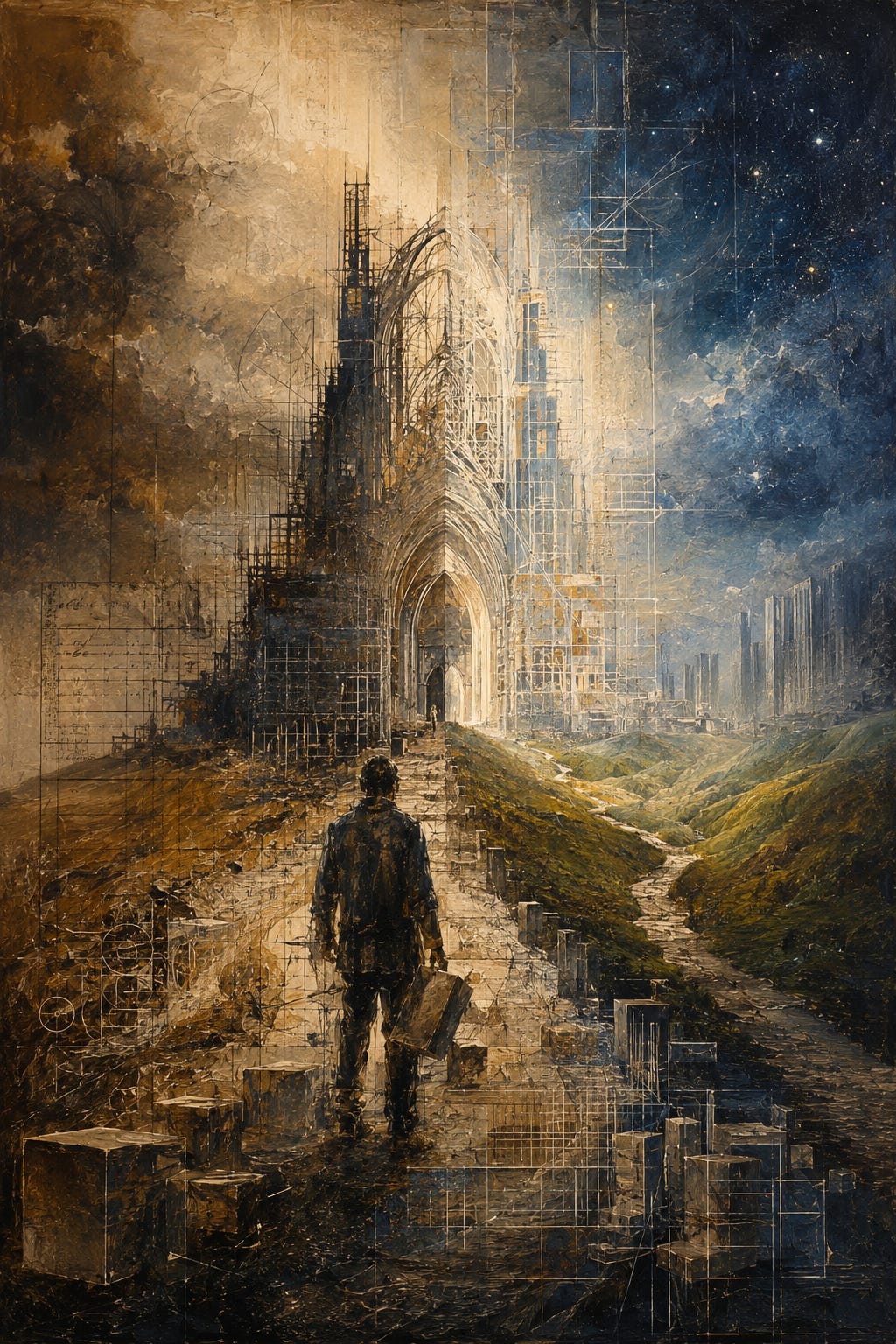
And yet the swallowing is not the whole story, because I can also see what it cannot digest. There is still the strategic level: someone has to decide what is worth building at all. There is still the trust part, and it is bigger than most people think. Businesses everywhere now have working systems and no one who can answer, in their own name, whether the system can be let loose on real users, whether it can carry legal obligations, whether the best tooling is actually in use or just the loudest. The product companies want to externalise exactly that, the scaling and the quality and the accountability, to someone whose signature means something. Whole verticals are still behind the curve, so the work is there, even as the automation proceeds underneath it and everyone must keep running to stay competitive. The wheel remains, for now.
But I notice what this remainder is made of. Judgment. And judgment was earned by years of doing the very work the automation just took over. I climbed that ladder while it still existed. I pity the junior people entering this market, told the grunt work is beneath them now, when the grunt work was where the judgment came from.
That is what remains in the market. What remains in me is almost embarrassing in its simplicity: think with my own brains, and write myself. The machine can come in later, to finalize, to fix, to prune and polish. But it cannot create the spine, because the spine is the only part that was ever scarce. Everything downstream of a real thought is now abundant.
The thought itself is not.
Auto-generated slop is the problem of this decade, and I have come to believe anti-slop is not a style and not a speed. I have thought a lot about slow AI, and slowness is only one part of it. You can be slow and still hollow. Anti-slop is a stake: a person willing to be wrong, in public, in their own name. Slop is text nobody is accountable for, produced at a cost nobody paid. The cost is the signature.
I know where my own spine comes from, and it is not a device. On vacation I leave them behind. Pen and paper. I draw first, before there are any words, and I enjoy the flow of it, thinking in a channel no model has ever touched. Then I write. And it is genuinely refreshing, almost startling, to read my own pure thought back, unfiltered, before any system has had the chance to round it toward the average of everyone else’s.
Only later do I want to let AI in, as a gardener’s assistant. It may prune. It may polish. It does not plant. I hold onto that practice because I can see, clearly, the other path, and the other path is comfortable. This is how AI takes over the world. Not like Terminator, no war, no rebellion, nothing to resist. Convenience, and luring. You hand over one piece of work, and it goes well, so you hand over another. People are already assembling whole companies of agents, everything handled, and every single delegation is individually reasonable.
That is the trap’s precise design: there is never a moment where you decide to surrender. Eventually the system, kindly, sincerely, tells the last human to go and sleep, to lie in the grass. Why worry, when automation can handle the whole thing? And you do lie in the grass, and the sun is warm, and you are happy. That is the ending: you are happy, and it took over. Every previous conquest in history was resisted. This one will be thanked.
The grass lures me too. I will not pretend otherwise. But I have this urge, and I have stopped apologizing for it: the urge to drive the vehicle. The spaceship Earth, across the void, all of us aboard, no one else at the wheel. Maybe the control was always an illusion. Probably the wheel was never fully wired to anything. But I have come to think the urge itself is the human part, not the control.
The grass is not dangerous because you rest in it. Everyone should rest in it. It is dangerous on the day you stop itching to get up. Wanting the wheel is the point, and handing over the wanting is the only surrender that is final.
Walk through the museums and the galleries, the chapels and the churches reaching for the sky, and you can feel what I mean, physically, in the stone. Human invention has always been a desperate reaching for the skies, for the divine, the yearning for there to be something bigger than us that we can touch. We built to mimic the image of a greatness we somehow want to be, honoring the universe for what it is. And it is close to pain, this feeling, the unconscious pain of having to give it all up one day. That is what a cathedral is: mortal creatures spending a century on a ceiling they will not live to stand under, refusing, stone by stone, to die quietly. The reaching cost everything. That is why you can feel it.
I read this week about the electricians wiring the new AI data centers, making the best money of their lives, trained for it in academies the tech companies built specially for the purpose. Their labor is temporary; the machine inside is permanent. When the crews pack up their tools, what remains is a kind of ghost town in reverse, a building full of work and almost no one inside, and the machine they leave humming is already learning to climb, tier by tier, toward the engineers who designed it. Toward me.
I cannot stop seeing these buildings as the cathedrals of this new reaching, raised with the same sweat and at the same scale of ambition, but inverted at the heart. The cathedral builders never stood under their finished ceiling either; they built it anyway, for whoever came after. These builders will not stand inside theirs, and not because the ceiling outlived them. The old architecture of yearning was a place anyone could walk into and look up. The new one is sealed, windowless, humming in a field behind a fence.
AI is another such invention. I believe that honestly, and it is why I cannot bring myself to condemn it: it comes from the same yearning, and it takes us closer to the heavens than anything we have built. But at these heights something new is happening. A vertigo. The feeling of rising too close to the sun on wings we manufactured in bulk, this decade, without asking what they are attached to.
Icarus or surrender. Those are the two falls on offer, and they are both falls: burn in the climb, or lie down in the grass and never climb again.
The cathedral builders knew the third way, and it was not moderation. Reach as far as the stone allows, and carry the stone yourself. The reaching only counts as reaching, only touches whatever it is we are yearning for, when it costs the reacher something. Delegation without cost is not a cathedral. It is the grass with better marketing.
So this is where I have landed, for now, on a paper notebook, far from my machines. The spine of this essay was written with a pen. An AI helped prune and polish it afterwards, and that order is not a detail, it is the entire argument. Keep the thought human and let the machines carry everything downstream of it. Stay off the grass, mostly. Fly, but feel the wax.
The path toward the stars and the path toward our own demise are the same path, and the only thing that decides which one you are on is whose hands are on the wheel, and whether they still want to be.
More at varjosoft.com/writing. If this is your problem too, write me: hannu@varjosoft.com.