The Need Disappears First
AI is not taking your job. It is removing the reason your job existed.

The story about AI taking jobs is wrong. Not entirely wrong, just pointed in the wrong direction. Machines are not the main act. The main act is that AI removes the reason certain work existed in the first place.
That is a different kind of loss.
Look at why a support team exists. It exists because a product produces confusion. A coordinator exists because people and systems fail to stay aligned on their own. A reporting layer exists because information has to be gathered somewhere, shaped into something legible, and carried upward to whoever signs the budget. Each role is a response to a constraint. The constraint is what gives the role meaning.
Then the constraint weakens.
The product starts explaining itself. Systems coordinate directly. The question reaches the answer without travelling through a chain of people who each had to read it, interpret it, and pass it along. The role lingers, of course. Budgets take time to adjust. Habits hold on. People defend the familiar, and managers especially, because nobody enjoys admitting an entire layer of the org chart has become optional.
Something has shifted underneath all of that. A room has gone away. The furniture inside it no longer matters, even if it is still there.
Friction was doing work
We notice friction when it irritates us. We rarely notice what it was holding up.
Take a parent trying to claim a benefit she is entitled to. There is a form. There is a waiting room. There is an identity check and a narrow opening hour and a phone line that closes before she can get to it after work. She makes the call three times across two weeks before someone picks up. The clerk is tired. The form is wrong. She comes back next month.
Some of that is bad design. Some of it is institutional scar tissue. Some of it, and this is the part most people miss, is load management.
Friction shapes demand. It forces people to decide whether their request is worth the effort. It slows the flow. It keeps a system with limited people, limited budget, and limited attention inside the range of what it can actually absorb.
Remove the effort and the demand changes shape. People ask more, because asking is easy. They test more cases. They appeal decisions they would have accepted before. They poke at the edges, because there is no penalty for trying. The system has to respond to all of it.
So the queue becomes a rate limit. The clerk becomes an eligibility model. The waiting room becomes a policy layer nobody sees. The form becomes a structured prompt with rejection logic running behind it.
Same pressure. Different surface.
The work was not only the work. It was also a valve.
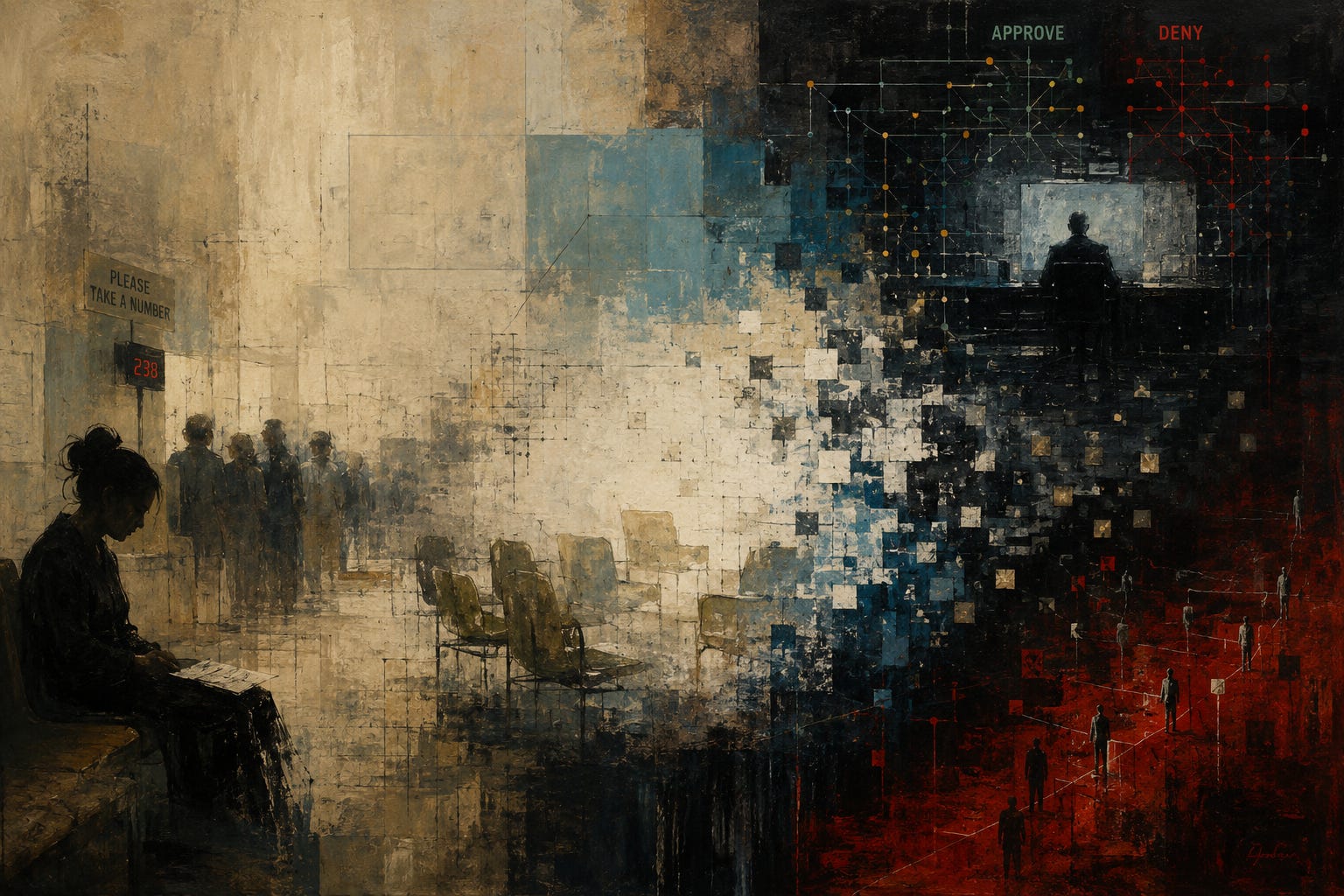
There is a second thing happening here that matters more than it sounds. The old queue was annoying, but visible. The new queue is invisible. The parent used to know she was waiting. Now she may simply be ranked, deprioritized, declined, or never surfaced. The clerk could see her face. The model cannot, and was not asked to.
Friction did not vanish. It changed register. It became harder to argue with.
Cheap action wakes things up
When action becomes cheap, people do not do the same things for less money. They attempt different things.
Cheap legal drafting makes smaller disputes worth pursuing. Cheap software makes internal tools worth building. Cheap analysis makes every decision demand a memo, and then a counter-memo, and then a slide deck nobody reads. Cheap content fills every niche until attention itself becomes the tax that nobody budgeted for.
The world does not become calm when execution gets cheap. It becomes noisy, busy, a little absurd.
Most forecasts miss this. They imagine the old demand flowing through a cheaper machine, like the same river with a wider bed. What actually happens is that the cheaper machine wakes demand that had been sleeping. A person who would never have hired a consultant asks an agent for ten strategies before lunch. A team that would never have commissioned software builds five small tools nobody asked for. A citizen who would have accepted a confusing decision now asks for explanation, appeal, comparison, precedent.
Some of this is good. Some of it is genuine need finally becoming visible after years of being suppressed by the cost of asking. Some of it is noise. Some of it is opportunism. Some of it is induced by the system itself, demand manufactured to fill capacity that suddenly exists.
The system has to sort all of it. Real need from expressed demand from manufactured demand from noise. That sorting is not neutral.
Whoever gets to classify a request as legitimate need holds something close to the original power that friction used to hold, only now it is concentrated in fewer hands and harder to see.
Prices fall, then the ground moves
When a need collapses, the market around it loosens. The price of serving that need falls because the cost structure that supported the price has broken. A thing that used to require hours, coordination, and expertise starts to look like a button.
That drop spreads sideways, the way water finds the lowest room in the house.
Businesses built on the old structure lose margin. People tied to that margin lose income. Buyers save in one place and spend differently elsewhere. Some adjacent services disappear because they were selling into the old bottleneck and had nothing else to offer.
The first effect feels like abundance. The second feels like weaker purchasing power. Both happen at once, in the same market, often to the same person. A market becomes more capable and more fragile together. More can be produced, while fewer people can afford the things that remain scarce.
The savings do not spread evenly. They gather. Whoever holds that pool starts shaping the layer above it.
There is also an asymmetry in how friction gets removed. For some people, AI becomes a concierge. Their bureaucracy melts. Their paperwork fills itself. Their disputes find competent representation overnight. For others, AI becomes the wall they cannot get past. Their applications get scored. Their appeals get auto-rejected. Their cases get closed before a human reads them.
The same technology behaves differently depending on which side of the gate you stand on.
The hard part moves to belief
Business does not become easy when building becomes easy.
Someone still has to buy. Someone has to trust the product, remember the brand, believe the claim, accept the risk, and choose this particular thing over the thousand other things that now look equally plausible from the outside. AI does not compress that part.
AI makes the market louder. More prototypes, more demos, more polished surfaces, more products that survive a launch video and quietly fall apart inside a real organization three weeks later. The buyer has already been burned. She has already paid for the thing that demoed beautifully and then could not handle her actual data, her actual edge cases, her actual scale. She is slower to believe now, and she should be.
Execution stops being a strong signal. Belief becomes the expensive thing.
Distribution, trust, reputation, timing, taste, category clarity. These matter more now precisely because they resist compression. They are social facts before they are operational ones.
You can generate a product. You cannot generate being trusted by the right buyer at the right moment. Not honestly, anyway. There are ways to imitate trust. Paid placement. Manufactured signals. Borrowed credibility. People are slowly getting better at smelling it, and the smell tends to linger.
The idea moves while you build it
When building gets cheaper, more people try more things. When more things get tried, the world changes faster. When the world changes faster, the original idea has a shorter and shorter life.
A workflow improvement becomes stale once someone removes the workflow entirely. A better dashboard loses its force once the buyer wants the decision itself, not the chart. A clever assistant feels small the moment the user starts expecting the whole outcome.
The need shifts while you are building toward it. That changes how you have to listen to people.
They ask for a tool and mean relief from a burden. They ask for a report and mean confidence. They ask for automation and mean permission to stop caring about a process they never wanted to own. The surface request becomes less reliable as a guide, and AI exposes that gap brutally.
The remaining work gets heavier
Less of the work sits in routine movement. More of it sits near judgment.
Which needs should be honored. Which should be denied. Which friction should remain in place because it was protecting something. Which process should disappear, and quickly. Which decisions can be delegated to a model, and who absorbs the failure when the delegation goes wrong at three in the morning.
Responsibility density rises.
A single approval now shapes thousands of downstream decisions. A policy choice decides who gets fast service and who gets stuck in the hidden queue. A product decision dissolves an entire category of human contact, and the person who made it may not realize the scale of what they did until much later.
The person left in the loop does fewer things. Each thing weighs more.
The parent from earlier comes back into focus here. Somewhere upstream of her rejected application, a system was approved by a person who probably never met anyone in her situation. The model was trained on cases the institution already understood. It learned to recognize the shape of the cases it was shown. Her case is slightly outside that shape, so the score is low, so the queue she joins is the deprioritized one, so the answer comes late or not at all. Nobody made a decision about her specifically. A decision was made once, about systems like the one she is now stuck inside, and that decision is doing its work in the background, every day, on every applicant who looks slightly wrong to it.
That is what responsibility density looks like in practice. One approval, years ago, in a meeting most attendees have forgotten, still shaping outcomes for people who will never know the meeting happened.
A public official approving an AI-driven process is deciding what kinds of need the institution can still see. A founder choosing a pricing model is deciding which customers exist for them. A platform designing a gate is deciding which forms of demand become legitimate, and which ones quietly stop being expressed.
The old work asked whether something could be done. The new work asks whether a need should exist in the system at all. That question has teeth.
Adjustment depends on who can argue
Here is the part I think most takes get wrong.
Markets can absorb collapsing needs and falling prices. They have done it before, more than once. What they need is one thing above all else. The definition of need has to remain open to challenge.
If many actors can question what counts as necessary, the system adjusts through tension. Different views of demand compete. Friction can be questioned, removed, or rebuilt where it serves people rather than incumbents.
If that ability narrows, the system hardens. Needs get defined from a smaller center. Friction returns selectively, protecting whoever survived the previous round. Compliance grows in places where small competitors cannot carry the weight. Access becomes conditional in ways that are difficult to contest, because the people who would contest it cannot get into the room. Or cannot get the form to load. Or cannot reach a human who will read the appeal.
The surface still looks efficient. The underlying choices move out of reach.
Information, institutions, education. They matter here for a practical reason. They decide who gets to argue about need in the first place. When fewer people can argue, fewer needs get questioned, and the collapse of old work becomes a transfer of authority rather than a release of capacity.
Let the right things die
AI will remove many forms of effort that deserve to disappear, and we should be honest about that. A lot of human life is spent navigating systems that should have been kinder, clearer, or simply unnecessary from the start. Waiting for answers. Translating bureaucracy. Copying data between boxes that were never meant to be separate. Asking permission from processes nobody remembers designing.
Let those die. They will not be missed.
The danger starts when the disappearance of need becomes something only powerful actors can direct. Then automation turns into settlement. The well-positioned decide which frictions vanish for them, which ones remain for everyone else, and which new dependencies become unavoidable. The concierge gets faster. The wall gets higher. The same technology, sorted by who paid for which side of it.
That is the tilt to watch. Not sudden robot unemployment, which is the cinematic version. Something more administrative. Harder to see. A gradual transfer of need-definition upward, one approval at a time, one disappeared layer at a time, one parent who never learns why the answer was no.
The work surviving is not the question worth asking.
The question is who gets to decide which needs are real. Argue about that one while you still can.
The dangerous moment comes when systems stop needing to explain why your need did not count.
This is brilliant Hannu! About AI and yet applicable to so much more. You write beautifully, clearly and with a distinctive voice. Your bit about responsibility density is in itself a political science and business admin class! Well done, thanks!!
This is brilliant Hannu! About AI and yet applicable to so much more. You write beautifully, clearly and with a distinctive voice. Your bit about responsibility density is in itself a political science and business admin class! Well done, thanks!!